
Happy latino children. Source: epSos.de | Wikimedia Commons
Helicobacter pylori (H. pylori) is one of the most common bacterial infections globally, and a major public-health concern across Latin America.
It usually begins in childhood, often without symptoms, and can persist into adulthood, increasing the risk of gastritis, ulcers, and even gastric cancer later in life.
A recent large-scale meta-analysis published in Gastroenterology by Chen et al. examined trends in H. pylori infection from 1980 to 2022 in multiple regions, including Latin America.
The findings are alarming: while infection rates among adults are slowly declining, infection in children has barely changed, especially in low- and middle-income regions like Latin America.
Table of Contents
What Researchers Did
Researchers reviewed data from 1748 articles from 111 countries, including 6,270,520 participants with total of 1,460 studies reporting H. pylori prevalence in adults and 441 studies reporting H. pylori prevalence in children/adolescents (ages 0-18).
The team used a systematic review and meta-analysis, adjusting results through multivariate modelling. They compared these findings with gastric cancer rates reported in the Global Burden of Disease Study and the Cancer Incidence in Five Continents database.
No Decline in H.pylori Infection Rates in Children

Child with fever. Source: Victoria Borodinova | PublicDomainPictures.Net
Between 2010 and 2022, that is, over the last three decades, the global prevalence of H. pylori among children and adolescents was around 35%. This means that roughly one in three children worldwide carries this bacterium.
Even more concerning: there has been no significant decline in infection rates among children from 2015- 2022 while adults decreased from 53% before 1999 to 44% using a multivariate meta-regression analysis. While adult infection has dropped by about 10 percentage points, children’s rates have stayed stubbornly high, especially in Latin America,
This decline in adults coincided with lower gastric cancer rates worldwide, suggesting that reducing H. pylori prevalence could be an effective public-health strategy to prevent gastric cancer. However, the authors caution that these are population-level associations that need confirmation through future randomized or cohort studies.
The authors emphasize the need for region-specific public-health programs and careful consideration of potential downsides such as antibiotic resistance and cost-effectiveness before implementing large-scale eradication campaigns.
While this meta-analysis is the most comprehensive to date, it faces limitations: Data quality varied between studies, and there were fewer pediatric data points from some Latin American countries.
Still, the trend is unmistakable, progress for children remains slow, uneven, and deeply linked to.
Why Childhood Infection Matters So Much

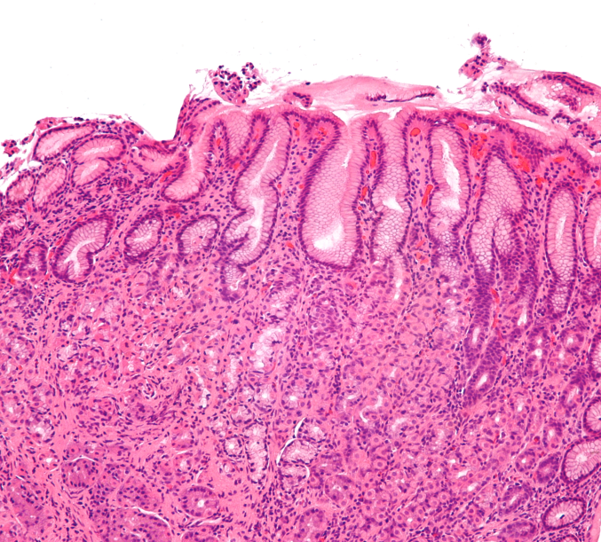
Acute gastritis. H&E stain of stomach biopsy showing H. pylori infection. Source: Nephron | Wikimedia Commons
Most H. pylori infections begin early in life, often before the age of 10, and once acquired, the bacterium can persist in the stomach for decades unless treated.
Children are typically infected through close household contact, especially from infected parents or siblings. This explains why prevalence is so high in families living in crowded or low-resource settings.
Over time, this silent infection can lead to chronic gastritis, a long-term inflammation of the stomach lining that damages tissue and increases the risk of peptic ulcers and gastric cancer.
The World Health Organization (WHO) classifies H. pylori as a Group 1 carcinogen, meaning there is strong evidence that it causes cancer in humans, specifically, non-cardia gastric adenocarcinoma.
If infection in children remains high, these regions risk sustaining a “reservoir” of infection that perpetuates the cycle of gastric disease into future generations.
Countries that have successfully lowered H. pylori prevalence in children, such as Japan and South Korea, have already seen marked declines in gastric cancer incidence over time.
H. pylori in Latin America: a Continuing Challenge
This is especially concerning for Hispanic and Latino populations, who already face higher rates of gastric cancer than non-Hispanic White populations in both Latin America and the United States.
In Latin American countries such as Chile, Colombia, and Costa Rica, gastric cancer remains among the top causes of cancer-related deaths, a pattern closely tied to persistent H. pylori infection during childhood.
In Latin America, infection rates are among the highest in the world, with studies showing 40–70% prevalence in children in some areas. Countries like Mexico, Peru, Colombia, and Brazil have long struggled with household transmission, poor sanitation, and limited access to clean water, all key factors that sustain H. pylori spread.
For Latin America, breaking this cycle will require early detection, family-based treatment, and public-health programs that address the social conditions fuelling transmission.
Take action: Protect Your Family’s Digestive Health

If your family has a history of gastritis, ulcers, or stomach cancer, or if you live in an area where H. pylori is common, ask your healthcare provider about simple non-invasive tests like the stool antigen test or urea breath test for children and adults.
You can learn more about H. pylori prevention and gastric cancer screening programs in Latin America through:
- Pan American Health Organization (PAHO)
- World Health Organization – H. pylori Resources
Early detection and treatment can make a lifelong difference. Healthy families start with awareness, and that begins today