Some bacteria cause disease quickly. Others have evolved a more unsettling strategy: they stay.
Persistent H. pylori infection can drive chronic inflammation and gradually create conditions for gastric cancer.
A recent Lancet Oncology analysis estimated that H. pylori accounted for approximately 51,000 cancer cases in South America and another 16,000 in Central America and the Caribbean in 2024.
Yet most people infected with H. pylori never develop cancer.
So what allows a bacterium to live in the stomach for decades, and why does that relationship eventually contribute to cancer in some people?
Let’s dive in.
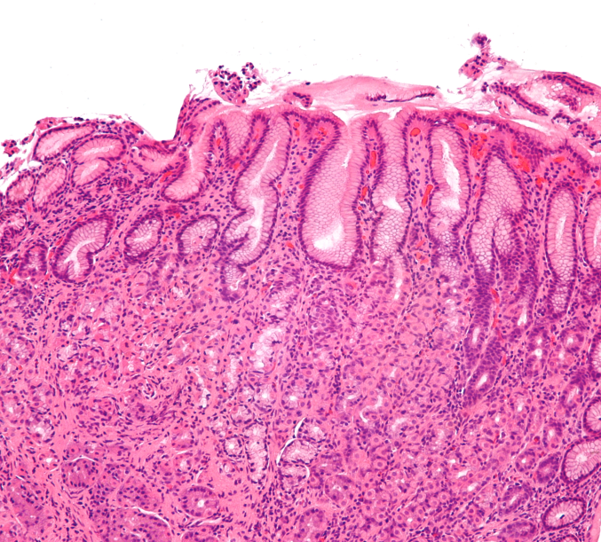
Gastritis due to Helicobacter Pylori. Source: Nephron via Wikimedia Commons.
Highlights
- H. pylori can persist in the stomach for decades and cause chronic inflammation.
- Most people infected with H. pylori do not develop gastric cancer.
- Cancer risk depends on interactions between bacterial virulence factors, host responses, and environmental exposures.
- Detecting and treating H. pylori can help reduce gastric cancer risk.
A Bacterium Built to Persist
The stomach seems like an unlikely place for bacteria to survive, but H. pylori is remarkably adapted to this acidic environment.
One of its tools is urease, an enzyme that converts urea into ammonia and helps create a more neutral environment around the bacterium. Once established, H. pylori can persist for decades because the immune response often fails to completely eliminate the infection.
This ability to persist is central to its relationship with cancer because it allows inflammation to continue for years.
From Infection to Chronic Inflammation
Although H. pylori infection is common, gastric cancer is not the outcome for most infected people. Wroblewski, Peek, and Wilson estimated that approximately 1–3% of infected individuals develop gastric adenocarcinoma.
For those who progress, the process can occur gradually over many years. Chronic gastritis can develop into gastric atrophy, intestinal metaplasia, dysplasia, and eventually gastric adenocarcinoma.
Persistent infection therefore creates an environment of prolonged inflammation and tissue damage that can increase the likelihood of cancer development.
Not All H. pylori Are the Same
One reason outcomes differ is that H. pylori strains are genetically diverse, and some carry virulence factors associated with more severe disease.
One of the most studied is CagA, a bacterial protein encoded within the cag pathogenicity island. Through a type IV secretion system, H. pylori can deliver CagA into gastric epithelial cells, where it interferes with pathways involved in cell growth, adhesion, polarity, and migration.
Strains carrying the cag pathogenicity island are associated with increased risks of severe gastritis, gastric atrophy, and gastric cancer compared with strains lacking it.
Another virulence factor, VacA, can alter gastric epithelial cells and suppress parts of the T-cell response, potentially helping H. pylori maintain its long-term presence in the stomach.
When the Immune Response Becomes Part of the Problem
The immune system recognizes H. pylori but often fails to eliminate it, resulting in chronic active gastritis that can persist for years.
This prolonged immune response exposes gastric tissue to inflammatory molecules and oxidative stress.
H. pylori infection has also been associated with oxidative DNA damage in gastric tissue, providing another potential link between chronic infection and carcinogenesis.
Over time, persistent inflammation, cellular damage, and repeated tissue repair can create conditions that favor the development of cancer.
Why Doesn't Everyone Develop Cancer?
The answer appears to lie in the interaction between the pathogen, the host, and the environment.
Bacterial virulence factors can influence how damaging an infection becomes, while genetic differences between individuals can alter the strength of the inflammatory response.
For example, certain IL-1β-associated genetic variants have been linked with increased inflammation, gastric atrophy, and gastric cancer risk among people infected with H. pylori.
Environmental exposures can further modify this risk. The review discusses high dietary salt intake and cigarette smoking as factors that may increase gastric cancer risk in people infected with H. pylori.
Cancer risk is therefore not determined simply by whether someone has H. pylori, but by how bacterial, host, and environmental factors interact during years of infection.
Why This Matters for Latin America
The biology becomes especially important when placed alongside the cancer burden in Latin America.
Unlike many cancer risk factors, however, H. pylori can be detected and treated. Studies reviewed by Wroblewski and colleagues found that eradication can reduce gastric cancer risk, particularly when treatment occurs before premalignant changes have developed.
This makes H. pylori testing and treatment not only an infectious disease strategy, but also a potential approach to cancer prevention.
From Infection Control to Cancer Prevention
H.pylori demonstrates how an infection can influence cancer risk over decades rather than directly causing a tumor.
Persistent infection drives chronic inflammation, bacterial virulence factors alter host cells, and genetic and environmental factors can further influence disease progression.
For Latin America, understanding these interactions could help identify populations at greatest risk and strengthen strategies for H. pylori testing, treatment, and gastric cancer prevention.
Cancer prevention can begin long before a tumor develops, including by detecting and treating an infection capable of helping create the conditions for cancer.
Stay Informed
Subscribe to Pathogenos for evidence-based insights on infectious diseases, emerging research, and the public health issues shaping Latin America and beyond.
From pathogen research to public health insight, delivered straight to your inbox.
Main Source:
Wroblewski LE, Peek RM Jr, Wilson KT. Helicobacter pylori and Gastric Cancer: Factors That Modulate Disease Risk. Clinical Microbiology Reviews. 2010;23(4):713–739. doi:10.1128/CMR.00011-10.